

Calories in an Egg: Eggs are one of those foods that almost everyone eats, but very few people actually know the calorie count for. You might be tracking your food, planning meals, or just curious — and the answer is not as simple as one number because it depends on the size of the egg and how you cook it.
This post covers everything. How many calories are in a boiled egg, a fried egg, scrambled eggs, just the white, just the yolk, and everything in between. You will also find out what those calories actually come with in terms of nutrition — because eggs are much more than just calories.
The Short Answer: Calories in One Large Egg
A single large egg has about 72 calories. That is the number for a whole egg, raw or cooked without any added oil, butter, or other ingredients.
Here is the basic breakdown of a large whole egg:
| Nutrient | Amount per Large Egg |
| Calories | ~72 kcal |
| Protein | ~6.3 g |
| Total Fat | ~5 g |
| Saturated Fat | ~1.6 g |
| Carbohydrates | ~0.4 g |
| Cholesterol | ~186 mg |
| Sodium | ~71 mg |
| Vitamin D | ~41 IU (about 6% daily value) |
| Vitamin B12 | ~0.5 mcg (about 21% daily value) |
| Choline | ~147 mg (about 27% daily value) |
| Selenium | ~15 mcg (about 28% daily value) |
| Riboflavin (B2) | ~0.2 mg (about 15% daily value) |
| 72 calories for something this nutritious is genuinely impressive. You get 6 grams of protein, a wide range of vitamins, and healthy fats — all in one small package that costs almost nothing. |
Calories by Egg Size
Egg sizes vary more than most people realize, and the calorie count changes with size. Here is how the numbers break down across the standard sizes you will find at the grocery store:
| Egg Size | Weight (approx) | Calories (whole egg) | Protein |
| Peewee | ~35g | ~41 cal | ~3.5g |
| Small | ~38g | ~54 cal | ~4.8g |
| Medium | ~44g | ~63 cal | ~5.5g |
| Large | ~50g | ~72 cal | ~6.3g |
| X-Large | ~56g | ~80 cal | ~7g |
| Jumbo | ~63g | ~90 cal | ~7.9g |
Most recipes and nutrition labels use large eggs as the standard. If you are using medium or jumbo eggs, the calorie count will shift by roughly 10 to 20 calories per egg.
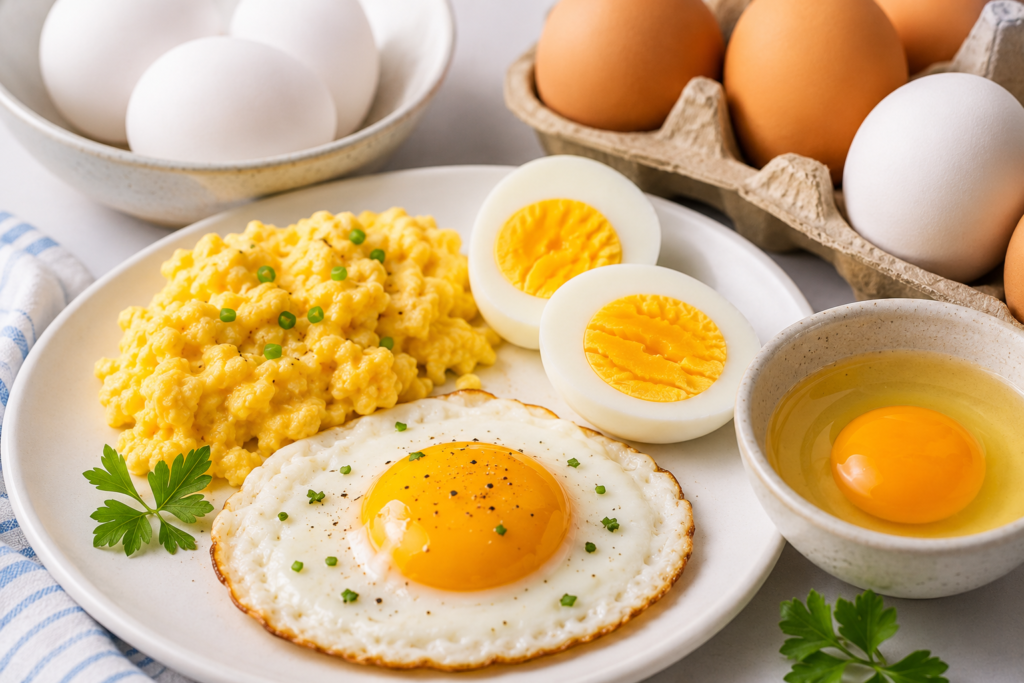
Calories in Egg White vs Egg Yolk
A lot of people separate their eggs — either eating only the whites for fewer calories or avoiding the yolk entirely because of old concerns about cholesterol. Here is what the numbers actually look like:
| Part of Egg | Calories | Protein | Fat | Key Nutrients |
| Egg White (large) | ~17 cal | ~3.6g | ~0g | Riboflavin, potassium, selenium |
| Egg Yolk (large) | ~55 cal | ~2.7g | ~4.5g | Vitamin D, B12, choline, iron, zinc |
| Whole Egg (large) | ~72 cal | ~6.3g | ~5g | All of the above combined |
The white is mostly protein with almost no fat or calories. The yolk has the majority of the calories but also almost all of the vitamins and minerals. If you are only eating egg whites, you are cutting calories but also losing most of the nutrition.
| Current nutrition research shows that for most healthy people, eating whole eggs — including the yolk — is fine and actually more beneficial than eating whites only. The vitamins and choline in the yolk support brain function, liver health, and energy levels. |
Calories in Eggs by Cooking Method
This is where the calorie count can really change. A plain boiled egg and a fried egg start with the same egg, but what you cook it in makes a significant difference.
| Cooking Method | Calories (1 large egg) | What Adds Calories |
| Raw | ~72 cal | Nothing added |
| Hard Boiled | ~72 cal | Nothing added — water only |
| Soft Boiled | ~72 cal | Nothing added — water only |
| Poached | ~72 cal | Nothing added — water only |
| Scrambled (no butter) | ~72 cal | Nothing added — pan only |
| Scrambled (with 1 tsp butter) | ~106 cal | +34 cal from butter |
| Scrambled (with milk) | ~80-90 cal | +8-18 cal from milk |
| Fried (1 tsp oil) | ~90 cal | +18-20 cal from oil |
| Fried (1 tbsp butter) | ~120 cal | +48 cal from butter |
| Omelette (no filling) | ~72-90 cal | Depends on fat used |
| Microwave cooked | ~72 cal | Nothing added |
As you can see, a boiled or poached egg keeps the calories exactly the same as a raw egg. Frying and scrambling are where calories creep up — and the type and amount of fat you cook in is what determines how much they increase.
| If you are watching calories, boiling or poaching your eggs is the best approach. You get all the nutrition with no extra calories. If you like fried eggs, use a light spray of cooking oil instead of a full teaspoon of butter. |
Calories in Common Egg Quantities
Most people do not eat just one egg. Here is a quick reference for how calories add up when you eat multiple eggs:
| Number of Large Eggs | Calories (boiled or raw) | Protein |
| 1 egg | ~72 cal | ~6.3g |
| 2 eggs | ~144 cal | ~12.6g |
| 3 eggs | ~216 cal | ~18.9g |
| 4 eggs | ~288 cal | ~25.2g |
| 5 eggs | ~360 cal | ~31.5g |
| 6 eggs | ~432 cal | ~37.8g |
Two to three eggs is the most common serving size for a breakfast meal. At 144 to 216 calories with about 12 to 19 grams of protein, that is a very filling and nutritious meal for a relatively low calorie cost.

Are Eggs Good for Weight Loss?
Yes — and for a few specific reasons that are worth knowing.
They are high in protein
Protein is the most filling macronutrient. Eating a high-protein breakfast has been shown in multiple studies to reduce how much people eat later in the day — not because of willpower, but because protein genuinely keeps you fuller longer than carbs or fat do. Two eggs gives you about 12 grams of quality protein.
They are low in calories relative to how filling they are
72 calories per egg is very low for how satisfying eggs are. Compare that to a slice of white bread at around 80 calories, which provides almost no protein and leaves you hungry much sooner. Eggs give you more fullness per calorie than most other breakfast options.
They keep blood sugar stable
Eggs have almost no carbohydrates. That means eating them does not spike your blood sugar the way a bowl of cereal or a piece of toast does. Stable blood sugar means fewer energy crashes and fewer sudden hunger spikes throughout the morning.
They are versatile and easy to prepare
One of the underrated reasons eggs support weight loss is that they are cheap, quick, and easy to cook in dozens of ways. When healthy food is convenient and affordable, you are more likely to keep eating it.
| A 2008 study published in the International Journal of Obesity found that people who ate eggs for breakfast lost significantly more weight than those who ate a bagel with the same number of calories. The difference was in satiety — the egg eaters stayed fuller for longer. |
Eggs and Cholesterol — The Real Story
For years, people were told to limit eggs because of cholesterol. The egg yolk does contain cholesterol — about 186 mg in a large egg. But the science on this has shifted significantly.
For most healthy people, eating dietary cholesterol does not meaningfully raise blood cholesterol levels. Your liver actually adjusts how much cholesterol it produces based on how much you get from food. When you eat more, it makes less.
Current dietary guidelines from major health organizations have removed the previous daily limit on dietary cholesterol. Most research now suggests that eating 1 to 2 whole eggs per day is fine for healthy adults, including those watching their heart health.
If you have a specific condition like type 2 diabetes or familial hypercholesterolemia, your doctor may give you different guidance. But for the average healthy person, whole eggs are not the problem they were once thought to be.
How Many Eggs Is Too Many?
There is no firm universal limit that applies to everyone. For most healthy adults, 1 to 3 eggs per day appears to be safe and nutritionally beneficial based on current evidence.
Some research has looked at people eating 3 to 7 eggs per week as a reasonable range. Others eat more than that with no issues. The bigger picture of what else you eat in a day matters far more than the exact egg count.
If you are eating eggs as part of a balanced diet with plenty of vegetables, fiber, and lean protein from other sources — you are not overdoing it with 2 eggs a day.
1300 Calorie Meal Plan: 7 Days of Simple, Filling Meals for Weight Loss
Lazy Weight Loss: 15 Effortless Habits That Actually Help You Lose Weight
Quick Calorie Reference for Popular Egg Dishes
Here is a rough calorie guide for common egg-based meals you might order or make at home:
| Egg Dish | Approx. Calories | Notes |
| 2 hard boiled eggs | ~144 cal | No added fat, most accurate count |
| 2 poached eggs | ~144 cal | No added fat |
| 2 scrambled eggs with butter | ~200 cal | Includes roughly 1 tsp butter |
| 2 fried eggs in oil | ~200 cal | Using 1 tsp vegetable oil |
| Plain omelette (2 eggs, no filling) | ~144-180 cal | Depends on cooking fat |
| Veggie omelette (2 eggs + veg) | ~180-220 cal | Adds minimal calories from veg |
| Cheese omelette (2 eggs + 1 oz cheese) | ~280-320 cal | Cheese adds 100-150 cal |
| Egg on toast (1 egg + 1 slice WW bread) | ~152 cal | Whole wheat toast ~80 cal |
| Eggs Benedict (2 eggs, restaurant) | ~600-900 cal | Hollandaise sauce is very high in fat |
| Deviled eggs (2 halves, 1 egg total) | ~120-140 cal | Mayo adds calories |
| Egg salad (1 cup) | ~350-400 cal | Mayo heavy — calorie dense |
Eggs Benedict and egg salad are where things get calorie-heavy fast — not because of the eggs, but because of the hollandaise sauce and mayonnaise. The egg itself is always the low-calorie part of those dishes.

Calories in an Egg: Best Low-Calorie Ways to Eat Eggs
If you are trying to keep calories down while still eating eggs regularly, here are the approaches that work best:
- Hard boil a batch on Sunday — ready to grab all week, zero extra calories
- Poach eggs — easy once you get the hang of it, no fat needed at all
- Scramble with a cooking spray instead of butter — saves 30 to 50 calories per serving
- Make a veggie omelette — the vegetables add almost no calories but a lot of volume and fiber
- Pair eggs with vegetables instead of toast — keeps carbs lower and adds nutrients
- Use one whole egg and one extra white to make a bigger serving for fewer calories
How many calories are in a large egg?
A large whole egg has about 72 calories. This number stays the same whether the egg is raw, hard boiled, soft boiled, or poached, because no extra ingredients are added. The calorie count only goes up when you fry or scramble eggs in oil or butter.
How many calories in 2 eggs?
Two large eggs have about 144 calories if cooked without added fat. If you scramble them in a teaspoon of butter, the count goes up to about 210 to 220 calories total. Two poached or hard boiled eggs stay at around 144 calories.
How many calories are in just the egg yolk?
One egg yolk from a large egg has about 55 calories and 4.5 grams of fat. It also contains most of the egg’s vitamin D, vitamin B12, choline, and other fat-soluble nutrients. The yolk is calorie-dense but nutritionally rich.
Do eggs have carbs?
Almost none. One large egg has about 0.4 grams of carbohydrates, which is essentially zero. This makes eggs a great option for people following low-carb or keto diets. All of the calories in an egg come from protein and fat.

Mitul Savaliya is a health and wellness writer based in India and the founder of 1MinuteHealthFix — a platform dedicated to making evidence-based health information quick, practical, and accessible to everyday people.
With a deep personal interest in how small daily habits shape long-term health, Mitul researches topics spanning gut health, sleep quality, metabolism, anti-inflammatory nutrition, and morning routines — drawing from published studies, clinical guidelines, and trusted sources like the NIH, PubMed, and leading health institutions.
Every article on 1MinuteHealthFix is written with a single goal: to give you one clear, actionable takeaway you can apply today. Mitul believes that lasting health is built not through extreme diets or complicated routines, but through simple, consistent actions done daily.
Disclaimer: Content on 1MinuteHealthFix is for informational purposes only and is not a substitute for professional medical advice. Always consult a qualified healthcare provider before making changes to your health routine.