
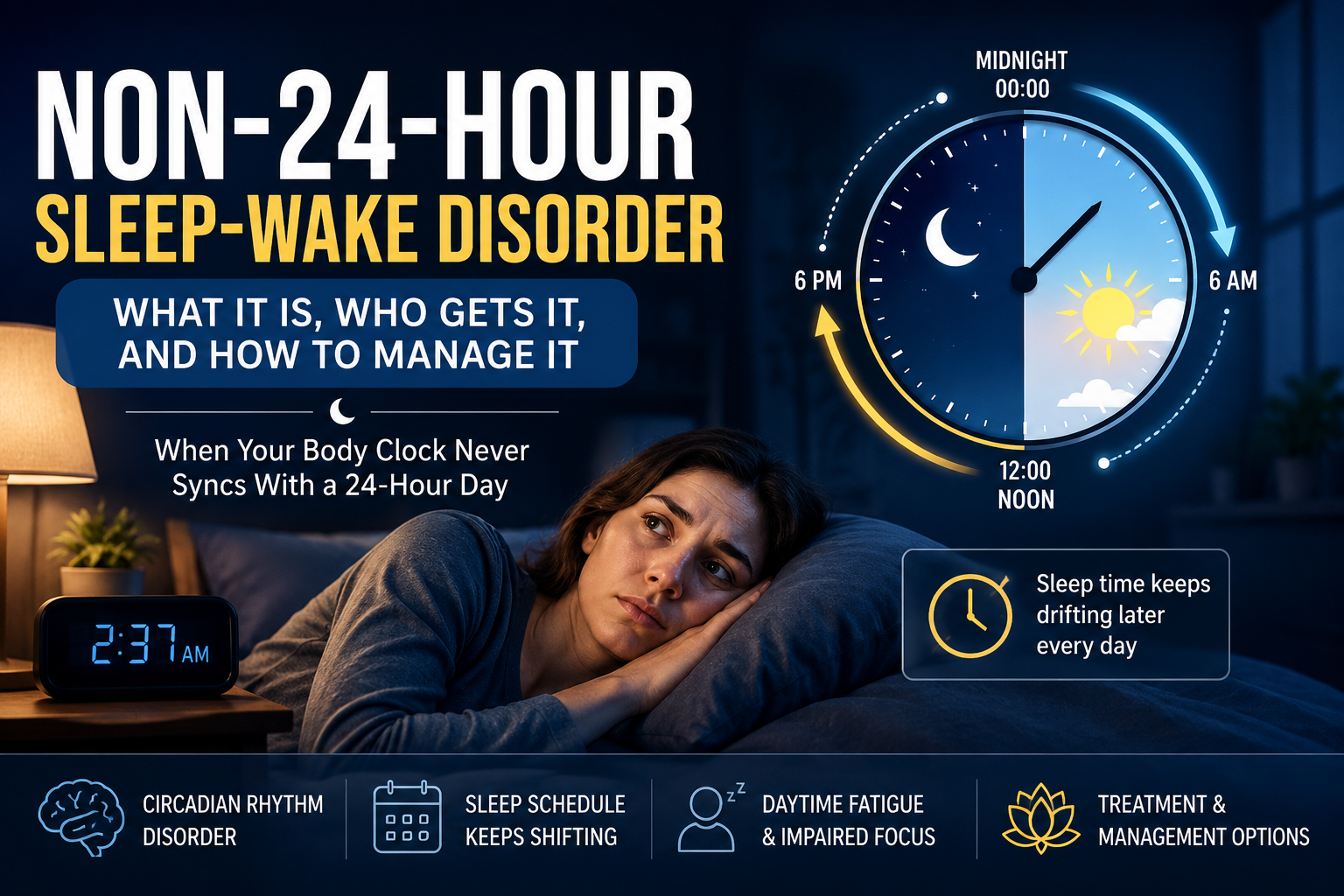
Non-24-Hour Sleep-Wake Disorder: Most people take it for granted that they can fall asleep at a reasonable hour at night and wake up in the morning without too much trouble. Their body naturally wants to follow a 24-hour cycle, more or less in line with the rise and fall of daylight.
But for people with Non-24-Hour Sleep-Wake Disorder, that does not happen. Their internal body clock runs on a slightly longer cycle than 24 hours — usually somewhere between 24.5 and 25.5 hours — and it never properly syncs with the actual clock on the wall.
The result is a sleep schedule that drifts later and later every day, week, and month. One week you might be falling asleep at midnight. Two weeks later, 3 AM. A month after that, you are sleeping during the day and awake all night. The cycle keeps moving, never settling.
This is not laziness. It is not a bad habit or a choice. It is a genuine neurological disorder involving the body’s circadian rhythm system — and it is one of the more disruptive and least talked-about sleep conditions that exists.
What Is Non-24-Hour Sleep-Wake Disorder?
Non-24-Hour Sleep-Wake Disorder, sometimes called Non-24 or free-running sleep disorder, is a circadian rhythm disorder. Circadian rhythms are the roughly 24-hour cycles your body uses to regulate sleep, wakefulness, hormone release, body temperature, and dozens of other biological processes.
In most people, the circadian clock is reset every day by exposure to light — particularly morning sunlight. Light signals reach the brain through the eyes and essentially tell the internal clock what time it is, keeping it synchronized with the outside world. This process is called photoentrainment.
In people with Non-24, this synchronization does not work properly. The internal clock keeps running on its own natural pace, which is slightly longer than 24 hours for most people. Without being reset by light cues, it drifts forward a little each day. Sleep, hunger, alertness, and other body functions all follow this drifting schedule rather than the actual time of day.
| Think of it like a clock that runs a little slow. If it loses 30 minutes a day and you never reset it, by the end of a month it is showing a completely different time than the real clock. Non-24 works the same way — except the clock is your entire biological system. |
Who Gets Non-24-Hour Sleep-Wake Disorder?
Blind and visually impaired people
Non-24 is most common in people who are completely blind. Because their eyes cannot detect light at all, the brain receives no light signals to reset the circadian clock each day. Research estimates that somewhere between 50 and 70 percent of completely blind people have Non-24.
This is the primary population studied in clinical trials and it is also the group for which the only FDA-approved medication for Non-24 was developed.
Sighted people with Non-24
Non-24 can also occur in people with normal or near-normal vision, though it is much rarer and less understood. In sighted people, the exact cause is not clear, but several factors may be involved:
- Abnormally long natural circadian period — some people’s internal clocks simply run longer than average
- Reduced sensitivity to light cues — the light signal may not be strong enough to reset the clock fully
- Neurological differences — the brain regions that process light signals and regulate circadian timing may function differently
- History of severe delayed sleep phase disorder — some cases appear to progress from DSPD to Non-24
Sighted people with Non-24 often go undiagnosed for years because the condition is less well known in this population, and their symptoms are frequently misattributed to insomnia, depression, irregular work schedules, or poor sleep habits.
Symptoms of Non-24-Hour Sleep-Wake Disorder
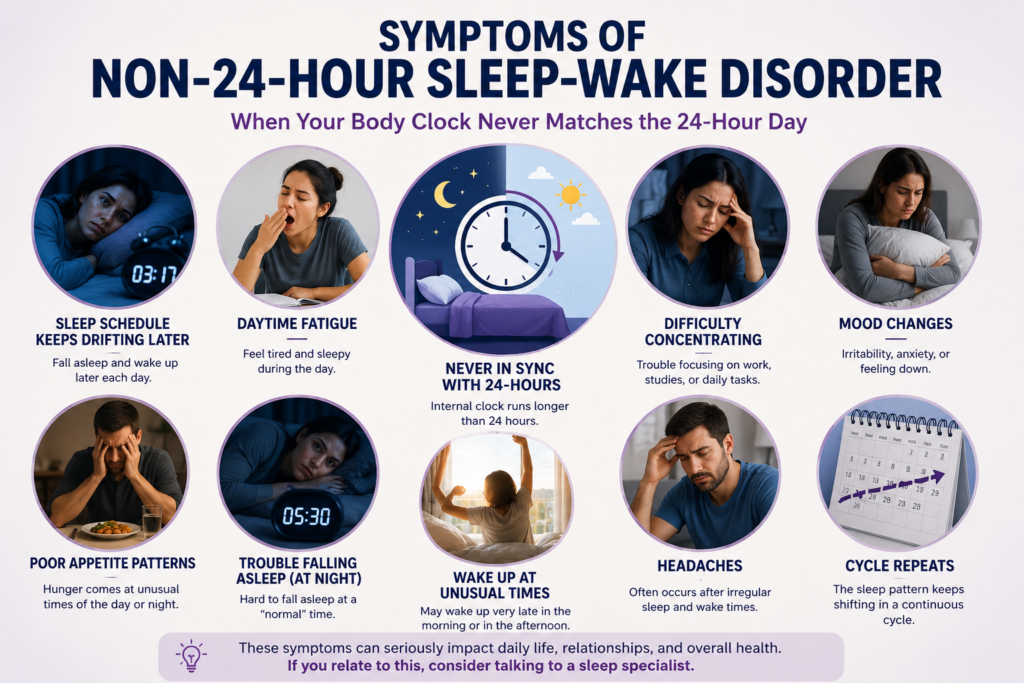
The symptoms of Non-24 follow a cyclical pattern that sets it apart from other sleep disorders. Unlike insomnia, which tends to be consistently bad, Non-24 creates periods of relatively normal sleep interspersed with periods of severely disrupted sleep — because the drifting schedule occasionally aligns with normal hours before drifting away again.
| Common Symptoms of Non-24 |
| Sleep timing that shifts later by 30 minutes to 2 hours every day Inability to fall asleep or wake up at socially normal times for extended periods Daytime sleepiness that worsens as the sleep schedule drifts into daytime hours Insomnia-like symptoms when trying to sleep at conventional times Periods of relatively normal sleep when the drifting cycle happens to align with nighttime Difficulty maintaining employment, school attendance, or social obligations Fatigue, difficulty concentrating, and mood disturbances tied to misaligned sleep A cyclical pattern — things improve for a few weeks, then worsen again as the cycle completes |
The cyclical nature is one of the most important features. If your sleep problems come and go in a regular pattern — weeks of bad sleep followed by weeks of better sleep — that cycle is a significant diagnostic clue.
| People with Non-24 often spend years trying to fix their sleep with standard advice: better sleep hygiene, avoiding screens, going to bed earlier. None of it works, because the problem is not behavioral. It is biological. Understanding this distinction is important for getting proper help. |
How Is Non-24 Different From Other Sleep Disorders?
Non-24 is sometimes confused with other conditions. Here is a simple comparison to help clarify the differences:
| Condition | Main Problem | Sleep Timing | Does It Cycle? |
| Non-24 Sleep-Wake Disorder | Internal clock drifts — never anchors to 24 hours | Keeps shifting later every day | Yes — cyclical pattern |
| Delayed Sleep Phase Disorder | Internal clock is shifted late but stable | Consistently late (e.g. 3 AM to noon) | No — stays shifted |
| Insomnia | Difficulty falling or staying asleep | Inconsistent, no fixed pattern | No |
| Shift Work Disorder | Sleep schedule conflicts with work hours | Disrupted by external schedule | Depends on shifts |
| Advanced Sleep Phase Disorder | Internal clock is shifted early | Consistently early (e.g. 7 PM to 3 AM) | No — stays shifted |
The key thing that distinguishes Non-24 from Delayed Sleep Phase Disorder is that Non-24 does not stay in one place. It keeps moving. People with DSPD are always late sleepers. People with Non-24 cycle through all hours of the day and night over weeks or months.
How Is Non-24-Hour Sleep-Wake Disorder Diagnosed?
Getting a diagnosis of Non-24 requires seeing a doctor or sleep specialist — ideally one with experience in circadian rhythm disorders, since the condition is not widely known among general practitioners.
The diagnostic process typically involves:
- Sleep diary — you keep a detailed log of when you fall asleep, wake up, and feel tired every day for several weeks. This helps reveal the drifting pattern.
- Actigraphy — you wear a small wrist device that tracks movement and light exposure 24 hours a day, usually for two to four weeks. This provides objective data on your activity and rest patterns.
- Medical history review — the doctor will ask about vision, neurological history, medications, and previous sleep issues.
- Ruling out other conditions — depression, thyroid disorders, and other sleep disorders may need to be excluded.
A sleep study (polysomnography) is not usually required to diagnose Non-24 specifically, though it may be done to rule out other sleep disorders like sleep apnea.
| If you suspect you have Non-24, start keeping a detailed sleep diary right now — before any appointment. Log every sleep and wake time, even if irregular, for at least two to four weeks. This documentation can be more helpful than any single test in convincing a doctor of the pattern. |
Treatment Options for Non-24
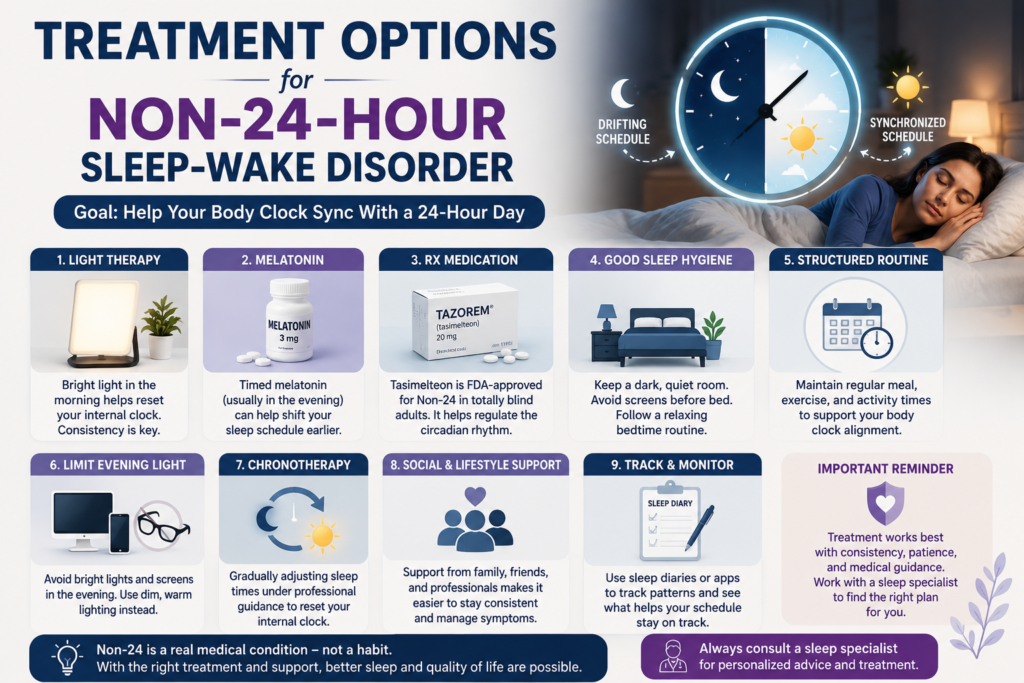
Managing Non-24 is challenging. There is no cure, and treatment approaches vary depending on whether the person is blind or sighted. The goal is to either anchor the circadian clock to a 24-hour cycle or to help the person function within their shifting schedule.
Tasimelteon (Hetlioz) — the only FDA-approved medication
In 2014, the FDA approved tasimelteon, sold under the brand name Hetlioz, specifically for Non-24-Hour Sleep-Wake Disorder in totally blind people. Tasimelteon is a melatonin receptor agonist — it works by activating the melatonin receptors in the brain that help regulate circadian timing.
Clinical trials showed that tasimelteon helped entrain (anchor) the circadian clock in a meaningful proportion of totally blind patients, improving nighttime sleep and daytime function. It is taken once daily at the same time each night.
Tasimelteon is approved for blind patients. Its use in sighted people with Non-24 is considered off-label and less studied.
Melatonin
Melatonin is often used in both blind and sighted people with Non-24, typically at low doses taken at a consistent time each day to try to anchor the internal clock. For blind people, it is one of the most accessible options because no light signals are available to reset the clock.
The timing and dose matter significantly. Taking melatonin at the wrong time in the circadian cycle can make things worse rather than better. A sleep specialist can help determine the right approach.
Light therapy for sighted people
For sighted people with Non-24, bright light therapy using a lightbox (typically 10,000 lux) in the morning can help strengthen the light signal to the brain and encourage the clock to anchor to a 24-hour day.
The challenge is timing. Because the circadian clock is constantly drifting, the right time to use light therapy changes day by day. This makes self-managed light therapy complicated and sometimes requires working closely with a specialist.
Chronotherapy
Chronotherapy involves deliberately shifting sleep later and later in a controlled way until the schedule cycles around to a target bedtime, which is then maintained with light, melatonin, or medication. It is rarely used now because it is disruptive and very hard to maintain in daily life.
Lifestyle accommodations
For people who cannot achieve full synchronization, working with the condition rather than against it may be the most realistic approach. This can include:
- Remote or flexible work arrangements that accommodate shifting schedules
- Open communication with employers, schools, or family about the condition
- Scheduling important commitments during the windows when sleep is most likely to be aligned
- Connecting with Non-24 patient communities for support and practical advice
| Many people with Non-24 find that the hardest part is not the disorder itself but the lack of understanding from others. Appearing ‘lazy’ or ‘undisciplined’ when the reality is a biological condition that makes conventional scheduling nearly impossible takes a real toll. Education and self-advocacy are important tools. |
7 Breathing Exercises for Anxiety That Actually Work (Fast Relief)
How to manage stress naturally at home: Simple Ways to Feel Calm and in Control
Living With Non-24: What It Actually Looks Like
For people without the condition, it can be difficult to understand how severely Non-24 disrupts daily life. It is not just about feeling tired. When your sleep schedule is running 12 hours opposite to the rest of the world, you are missing meetings, missing family events, losing jobs, and watching your social life quietly disappear — not by choice, but because your body simply will not cooperate.
During the periods when the sleep cycle aligns with daytime living, things feel manageable. Then the drift begins again and everything unravels. This cyclical nature also makes it harder to get support, because when things are temporarily fine, people around you may assume the problem was solved or was not real to begin with.
People with Non-24 often describe years of being misdiagnosed with depression, insomnia, or anxiety — not because those conditions are not real factors, but because the underlying circadian disorder was never identified as the root cause.
When to See a Doctor
You should talk to a doctor if:
- Your sleep timing shifts later consistently over weeks or months rather than staying in one place
- You are unable to maintain a regular sleep schedule despite genuine effort
- Your sleep problems follow a cyclical pattern — good for a few weeks, then bad for a few weeks
- You are totally blind and experiencing chronic sleep disruption
- Sleep problems are seriously affecting your ability to work, study, or maintain relationships
Ask specifically about circadian rhythm disorders and whether a referral to a sleep specialist or chronobiologist would be appropriate. Bring your sleep diary if you have one. The more data you can show, the easier it is to identify the pattern.
How common is Non-24 in sighted people?
Non-24 is rare in sighted people. Exact numbers are difficult to pin down because many cases go undiagnosed or are misidentified as other conditions like insomnia or delayed sleep phase disorder. It is significantly more common in people who are totally blind, affecting an estimated 50 to 70 percent of that population.
Can children have Non-24?
Yes, though it is uncommon. Cases have been documented in children, particularly in those who are blind. In sighted children, Non-24 is very rare and may be associated with neurological conditions. A child with a consistently drifting sleep schedule that does not respond to normal sleep hygiene measures should be evaluated by a pediatric sleep specialist.
Does Non-24 get worse over time?
Non-24 itself does not necessarily progress to become more severe, but its impact can worsen if left unmanaged — through job loss, social isolation, secondary depression, or physical health effects from chronic circadian misalignment. Getting a proper diagnosis and working with a specialist to find a management strategy is important for long-term quality of life.

Mitul Savaliya is a health and wellness writer based in India and the founder of 1MinuteHealthFix — a platform dedicated to making evidence-based health information quick, practical, and accessible to everyday people.
With a deep personal interest in how small daily habits shape long-term health, Mitul researches topics spanning gut health, sleep quality, metabolism, anti-inflammatory nutrition, and morning routines — drawing from published studies, clinical guidelines, and trusted sources like the NIH, PubMed, and leading health institutions.
Every article on 1MinuteHealthFix is written with a single goal: to give you one clear, actionable takeaway you can apply today. Mitul believes that lasting health is built not through extreme diets or complicated routines, but through simple, consistent actions done daily.
Disclaimer: Content on 1MinuteHealthFix is for informational purposes only and is not a substitute for professional medical advice. Always consult a qualified healthcare provider before making changes to your health routine.