
Cures for Sleep Disorders: Bad sleep ruins everything. Your mood takes a hit. Your focus disappears. You eat more, move less, and by 3 in the afternoon you feel like you are wading through mud just to get through a normal day.
If this sounds familiar, you are far from alone. Sleep disorders affect a huge portion of the adult population — estimates suggest somewhere between 50 and 70 million Americans experience ongoing sleep problems. Insomnia alone is one of the most common health complaints doctors hear.
The good news is that many sleep disorders respond well to the right combination of lifestyle changes, behavioral approaches, and — when needed — medical treatment. You do not always need sleeping pills to sleep better. In fact, for most common sleep disorders, non-medication approaches work just as well or better in the long run.
This post covers 15 practical remedies for sleep disorders — from simple things you can try tonight to more structured approaches worth discussing with a doctor. Not every remedy works for every person or every type of sleep disorder, so use this as a starting point to find what fits your situation.
First: What Type of Sleep Disorder Do You Have?
The word ‘sleep disorder’ covers a wide range of conditions. The right remedy depends significantly on what type of problem you are dealing with. Here is a quick overview:
| Sleep Disorder | Main Problem | How Common |
| Insomnia | Trouble falling asleep, staying asleep, or waking too early | Very common — affects up to 30% of adults |
| Sleep Apnea | Breathing repeatedly stops during sleep | Common — affects an estimated 22 million Americans |
| Restless Legs Syndrome (RLS) | Uncomfortable sensations in legs, urge to move them at night | Affects 7-10% of the population |
| Circadian Rhythm Disorders | Sleep timing is misaligned with the 24-hour day | Includes delayed sleep phase, Non-24, jet lag, shift work disorder |
| Narcolepsy | Excessive daytime sleepiness, sudden muscle weakness | Less common — affects about 1 in 2,000 people |
| Hypersomnia | Excessive sleepiness even after enough sleep | Less common, often linked to other conditions |
| Parasomnias | Abnormal behaviors during sleep (sleepwalking, night terrors) | More common in children, can occur in adults |
Remedies that help insomnia may not help sleep apnea. Treatments for circadian rhythm disorders are different from treatments for restless legs. Knowing what you are dealing with helps you focus on what is actually likely to help.
| If you have never been evaluated for a sleep disorder and your sleep problems have lasted more than a few weeks, seeing a doctor is worth it. Some sleep disorders — especially sleep apnea — have health consequences beyond just feeling tired, and they need proper diagnosis and treatment. |
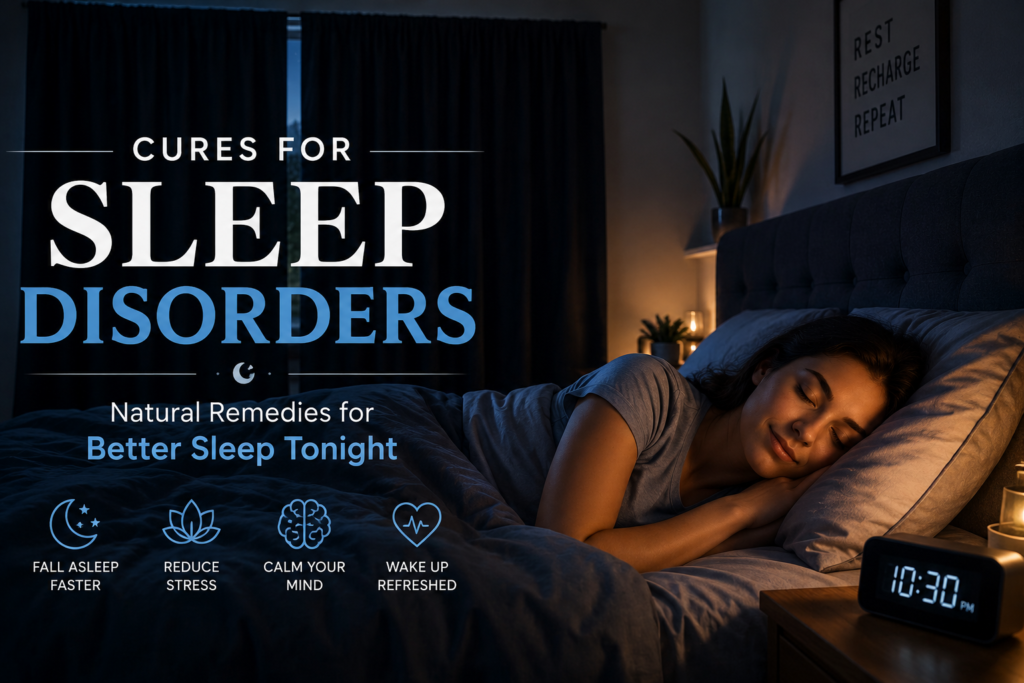
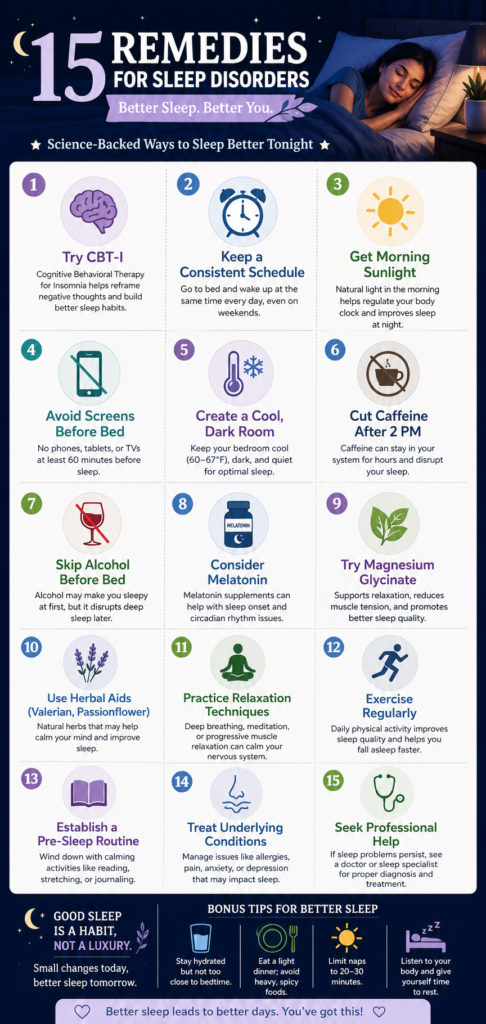
15 Remedies for Cures for Sleep Disorders
Behavioral and Lifestyle Remedies
These approaches work for a wide range of sleep disorders and are often the first line of treatment recommended by sleep specialists — not because they are easy, but because they address the root causes of most sleep problems.
| 1. Cognitive Behavioral Therapy for Insomnia (CBT-I) |
| CBT-I is not just talk therapy — it is a structured program that changes the thoughts and behaviors that keep insomnia going. It typically includes sleep restriction, stimulus control, relaxation training, and addressing the mental patterns that create anxiety around sleep. Multiple large studies have shown CBT-I works better than sleeping pills for long-term insomnia and does not carry the risks of medication dependence. You can access it through a therapist, online programs, or apps like Sleepio. It takes a few weeks but the results tend to last. Quick tip: CBT-I is considered the gold-standard first-line treatment for chronic insomnia by the American College of Physicians. Ask your doctor for a referral or look for a certified CBT-I therapist. |
| 2. Fix Your Sleep Schedule — and Actually Stick to It |
| Going to bed and waking up at the same time every single day — including weekends — is one of the most powerful things you can do for sleep. Your circadian rhythm runs on consistency. Every time you sleep in on weekends or stay up late, you are essentially giving yourself social jet lag and weakening the body’s natural sleep drive. Pick a wake time and protect it, even if you slept badly the night before. The sleep drive builds up through the day and helps you fall asleep more easily the next night. Quick tip: Start with the wake time, not the bedtime. A fixed wake time anchors the whole system. Bedtime tends to self-correct within a week or two once the wake time is consistent. |
| 3. Get Morning Sunlight Within an Hour of Waking |
| Light is the most powerful signal your body uses to set its internal clock. Getting outside — even for just 5 to 10 minutes — within the first hour after waking sends a strong signal to your brain that the day has started. This helps set your circadian rhythm so your body naturally starts producing melatonin at the right time in the evening, making it easier to fall asleep at a normal hour. This works for insomnia, delayed sleep phase disorder, circadian rhythm issues, and general poor sleep quality. Quick tip: Even on a cloudy day, outdoor light is far brighter than indoor lighting and still provides effective light exposure. You do not need direct sunlight — just go outside. |
| 4. Practice Sleep Restriction Therapy |
| This sounds counterintuitive but it works very well for insomnia. The idea is to temporarily limit your time in bed to roughly how long you are actually sleeping — even if that is only 5 or 6 hours — and then gradually extend it as sleep efficiency improves. Lying in bed for 9 hours but only sleeping 5 of them actually makes insomnia worse because it fragments sleep and trains your brain to associate the bed with wakefulness. Sleep restriction rebuilds the association between bed and actual sleep. It is hard at first but results typically appear within 1 to 2 weeks. Quick tip: This approach is best done with guidance from a CBT-I therapist or sleep specialist, especially if you have other health conditions. It is a cornerstone of CBT-I programs. |
| 5. Remove Screens From the Bedroom — Completely |
| Your bedroom should only be used for sleep and intimacy. That is not just a nice idea — it is a behavioral principle called stimulus control. When you watch TV, scroll your phone, or work in bed, you are training your brain to stay alert in that environment. The bed stops being a cue for sleep and starts being a cue for stimulation. Move all screens out of the bedroom. Charge your phone in another room. Use a regular alarm clock. Give your brain back the association between lying in bed and falling asleep. Quick tip: If you struggle to stop using your phone at night, set it to charge in a specific spot outside the bedroom before you start your wind-down routine. Making it physically inconvenient is more effective than willpower alone. |
Sleep Environment and Hygiene Remedies
| 6. Cool Your Bedroom Down |
| Your core body temperature needs to drop by about 1 to 2 degrees Fahrenheit to initiate and maintain sleep. A cooler room helps this happen faster and more completely. The ideal sleep temperature for most people is between 60 and 67 degrees Fahrenheit (15 to 19 Celsius). If your room is too warm — especially in summer — it can cause you to wake more during the night and spend less time in deep sleep stages. A fan, open window, or air conditioning all help. Cooling bedding and breathable pajamas also make a difference. Quick tip: If you tend to sleep hot, look into cooling mattress toppers or moisture-wicking bedding. A warm shower or bath about an hour before bed also helps — it raises your skin temperature temporarily, which paradoxically accelerates the core body temperature drop that triggers sleepiness. |
| 7. Block Out Light and Noise |
| Light and noise are two of the most common sleep disruptors. Even small amounts of light — a streetlight through curtains, a phone screen across the room, a standby light on an appliance — can suppress melatonin and disrupt sleep cycles. Heavy blackout curtains or a sleep mask are straightforward fixes. Noise is trickier because it is not always under your control, but white noise machines, earplugs, or brown noise played through a speaker can mask irregular sounds that cause micro-arousals during the night. Quick tip: Pink or brown noise tends to be less jarring than white noise for some people. There are free apps and YouTube videos with hours of it. Try it for a week and see whether it changes how rested you feel in the morning. |
| 8. Cut Caffeine Off Earlier Than You Think |
| Caffeine has a half-life of about 5 to 7 hours. That means if you drink a coffee at 3 PM, half of that caffeine is still in your system at 8 or 9 PM. If you have a second cup at 5 PM, you are going to bed with a significant amount of caffeine still circulating. Caffeine blocks adenosine — the chemical that builds up through the day and makes you feel sleepy. Even if you fall asleep fine with caffeine in your system, it reduces deep sleep quality measurably. The cut-off most sleep specialists suggest is 1 to 2 PM, or at least 8 hours before bed. Quick tip: Hidden caffeine sources trip people up: tea (including green tea), dark chocolate, some soft drinks, and headache medications like Excedrin all contain caffeine. Check what you are consuming in the afternoon. |
| 9. Stop Alcohol as a Sleep Aid |
| Alcohol makes you feel sleepy, which is why many people use it to wind down. But it significantly disrupts sleep quality — particularly in the second half of the night. Alcohol suppresses REM sleep early in the night, and as it metabolizes, it causes a rebound effect that fragments sleep in the early morning hours. People who drink before bed often wake between 2 and 4 AM and struggle to fall back asleep. Over time, relying on alcohol for sleep also builds tolerance, meaning you need more for the same effect. Quick tip: If you drink in the evenings and consistently wake in the early hours, cutting out the nightcap for two weeks and observing what changes can be very revealing. Many people are surprised by how much their sleep quality improves. |
Natural and Supplement-Based Remedies
| 10. Melatonin — Used Correctly |
| Melatonin is one of the most widely used sleep supplements, but most people take it wrong. It is not a sedative — it does not make you sleepy the way a sleeping pill does. Melatonin is a timing signal. It tells your brain that night has arrived. Taking a large dose (like 10 mg) an hour before bed is not how it works best. Research suggests low doses of 0.5 to 1 mg taken 90 minutes to 2 hours before your desired sleep time are more effective than high doses. Melatonin works best for circadian rhythm issues — jet lag, shift work, delayed sleep phase — not for pure insomnia where timing is not the issue. Quick tip: Less is more with melatonin. Start at 0.5 mg and see whether it helps. Higher doses can cause grogginess and actually disrupt your natural melatonin production over time. |
| 11. Magnesium Glycinate |
| Magnesium is involved in over 300 biochemical reactions in the body, including several that regulate sleep and nervous system function. Magnesium glycinate — one of the most bioavailable forms — has research supporting its role in reducing cortisol, calming the nervous system, and improving sleep quality, particularly for people with insomnia and restless legs syndrome. It is not a knockout supplement, but many people report falling asleep faster and sleeping more deeply after a few weeks of consistent use. Quick tip: A typical dose used in sleep research is 200 to 400 mg of elemental magnesium glycinate taken in the evening. It is generally well-tolerated. Check with your doctor if you have kidney problems, as magnesium is processed by the kidneys. |
| 12. Valerian Root and Passionflower |
| Valerian root is one of the oldest and most studied herbal sleep remedies. It appears to work by increasing GABA activity in the brain — the same neurotransmitter that many prescription sleep medications target, though with a much milder effect. Research results are mixed but lean positive for sleep onset and quality, particularly with regular use rather than a single dose. Passionflower is another herb with calming properties and some evidence for reducing anxiety-related sleep problems. Both are available as teas, tinctures, or capsules. Quick tip: Herbal remedies can interact with medications. If you are taking any prescription drugs — particularly antidepressants, anti-anxiety medications, or blood thinners — check with your doctor before adding any herbal supplement. |
| 13. Relaxation Techniques Before Bed |
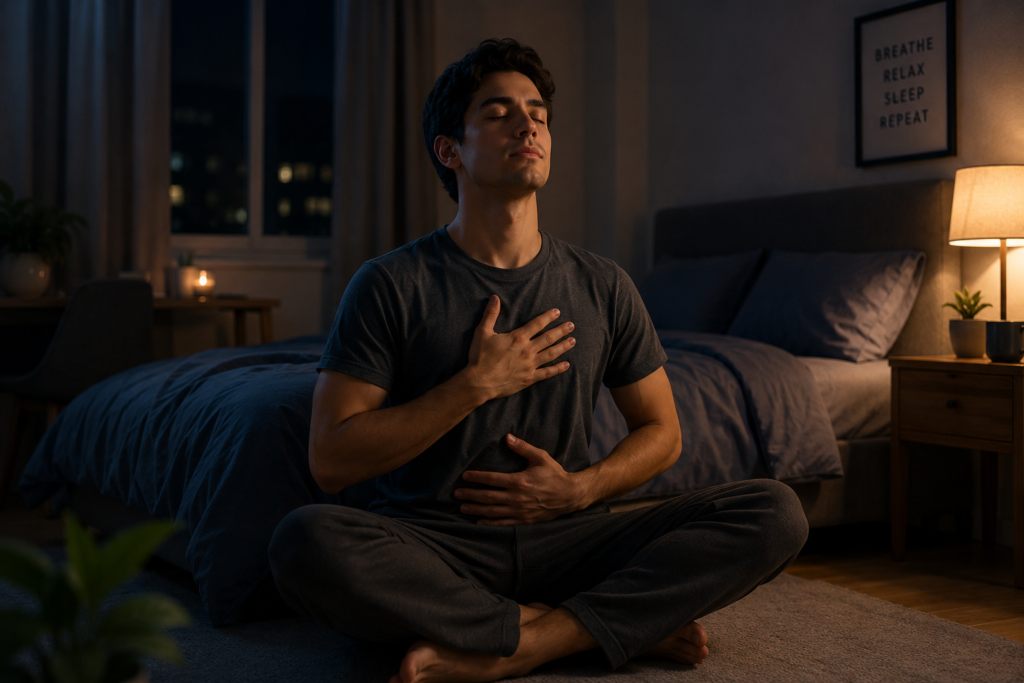
| Progressive muscle relaxation, deep breathing, guided body scans, and meditation all activate the parasympathetic nervous system — your body’s calm-down mode — which is the opposite of the fight-or-flight state that keeps many people awake at night. Even 10 minutes of slow, deep breathing before bed can measurably reduce the time it takes to fall asleep. The 4-7-8 breathing method (in for 4, hold for 7, out for 8) is particularly effective for winding down because the long exhale engages the vagus nerve and drops heart rate and cortisol. Quick tip: Apps like Calm, Headspace, and Insight Timer have free guided sleep meditations and body scans. Starting with a guided version is easier than trying to do it on your own, especially if your mind tends to race. |
Medical Treatments for Sleep Disorders
When lifestyle and behavioral changes are not enough, medical treatments may be needed — particularly for sleep apnea, restless legs syndrome, narcolepsy, and severe or chronic insomnia. These require a doctor’s evaluation and prescription.
| 14. CPAP Therapy for Sleep Apnea |
| Continuous Positive Airway Pressure (CPAP) therapy is the most effective treatment for obstructive sleep apnea. A CPAP machine delivers a constant stream of pressurized air through a mask worn during sleep, which keeps the airway open and prevents the repeated breathing interruptions that characterize sleep apnea. Many people experience dramatic improvements in sleep quality, daytime energy, concentration, and mood within days of starting CPAP therapy. If you snore loudly, wake up feeling unrefreshed no matter how long you sleep, or have been told you stop breathing during sleep, ask your doctor about a sleep study. Quick tip: CPAP compliance is the main challenge — some people find the mask uncomfortable at first. Modern machines are much quieter and more comfortable than older versions. Trying different mask styles and working with your sleep clinic to optimize the settings significantly improves comfort. |
| 15. Prescription Medications — When and Why |
| For certain sleep disorders, prescription medication is the right tool and there is no reason to avoid it when properly prescribed. Options vary significantly by condition. For insomnia, doctors may prescribe short-term sleep aids, low-dose antidepressants like trazodone that have sedating effects, or newer medications like suvorexant that work differently from older sleeping pills. For restless legs syndrome, dopamine agonists, gabapentin, or iron supplementation (if iron is low) may be prescribed. For narcolepsy, stimulants and sodium oxybate are commonly used. For circadian rhythm disorders, tasimelteon is FDA-approved for Non-24 in blind patients. The key is matching the medication to the specific disorder — a sleeping pill for sleep apnea does not fix sleep apnea. Quick tip: Never take prescription sleep medications without proper medical supervision. Many carry risks of dependence or interactions. They are most effective when used short-term alongside behavioral changes, not as a standalone long-term solution for most sleep disorders. |
Quick Reference: Which Remedy Helps Which Disorder
| Remedy | Insomnia | Sleep Apnea | Circadian Disorders | RLS | Anxiety-Related Sleep |
| CBT-I | Best fit | — | Partial | — | Yes |
| Fixed sleep schedule | Yes | Yes | Yes | Yes | Yes |
| Morning sunlight | Yes | — | Best fit | — | Yes |
| Sleep restriction | Best fit | — | — | — | Yes |
| No screens in bedroom | Yes | — | Yes | — | Yes |
| Cool bedroom | Yes | Yes | — | — | Yes |
| Cutting caffeine | Yes | Yes | Yes | — | Yes |
| No alcohol before bed | Yes | Yes | — | Yes | Yes |
| Melatonin | Partial | — | Best fit | — | — |
| Magnesium glycinate | Yes | — | — | Yes | Yes |
| Valerian/Passionflower | Partial | — | — | — | Yes |
| Relaxation techniques | Yes | — | — | — | Best fit |
| CPAP therapy | — | Best fit | — | — | — |
| Prescription medication | Partial | Varies | Yes | Yes | Varies |
7 Breathing Exercises for Anxiety That Actually Work Fast Relief
Non-24-Hour Sleep-Wake Disorder: What It Is, Who Gets It, and How to Manage It
What to Do If Nothing Seems to Work
If you have tried multiple remedies over several weeks and your sleep is still significantly disrupted, it is time to see a doctor. There may be an underlying condition driving the sleep problem that has not been identified yet.
Things worth asking your doctor about:
- A referral to a sleep specialist or sleep clinic
- An overnight sleep study (polysomnography) to rule out sleep apnea or other physical sleep disorders
- Blood tests to check iron, thyroid function, vitamin D, and B12 — deficiencies in all of these can significantly affect sleep
- A review of your current medications — many common drugs affect sleep quality as a side effect
- Mental health screening — anxiety and depression are among the most common causes of chronic insomnia and are often undertreated
Sleep problems that last more than three months and affect your daily functioning are considered chronic and deserve proper medical evaluation. You do not have to just live with it.
Medical Disclaimer: This article is for informational purposes only and is not a substitute for professional medical advice, diagnosis, or treatment. If you have persistent or severe sleep problems, please speak with a qualified doctor or sleep specialist before trying new treatments.
Can sleep disorders be cured permanently?
It depends on the type. Insomnia caused by stress or poor sleep habits can often be fully resolved with CBT-I and lifestyle changes. Circadian rhythm disorders can sometimes be managed well enough that they no longer significantly impact daily life. Sleep apnea is managed rather than cured — CPAP therapy controls it effectively but symptoms return without treatment. Narcolepsy is a lifelong condition that is managed with medication. Restless legs often responds well to treatment but may require ongoing management. The goal for most sleep disorders is effective long-term management rather than a one-time cure.
What is the fastest way to fix a sleep disorder?
There is no single fastest fix because it depends entirely on the type of disorder. For situational insomnia triggered by stress, removing the stressor and using relaxation techniques can produce quick results. For circadian issues from jet lag or shift changes, melatonin timing and light exposure adjustments can work within a few days. For chronic insomnia, CBT-I produces meaningful improvements within 4 to 8 weeks. For sleep apnea, CPAP can improve sleep dramatically from the first night. No remedy works overnight for every type of sleep disorder.

Mitul Savaliya is a health and wellness writer based in India and the founder of 1MinuteHealthFix — a platform dedicated to making evidence-based health information quick, practical, and accessible to everyday people.
With a deep personal interest in how small daily habits shape long-term health, Mitul researches topics spanning gut health, sleep quality, metabolism, anti-inflammatory nutrition, and morning routines — drawing from published studies, clinical guidelines, and trusted sources like the NIH, PubMed, and leading health institutions.
Every article on 1MinuteHealthFix is written with a single goal: to give you one clear, actionable takeaway you can apply today. Mitul believes that lasting health is built not through extreme diets or complicated routines, but through simple, consistent actions done daily.
Disclaimer: Content on 1MinuteHealthFix is for informational purposes only and is not a substitute for professional medical advice. Always consult a qualified healthcare provider before making changes to your health routine.